

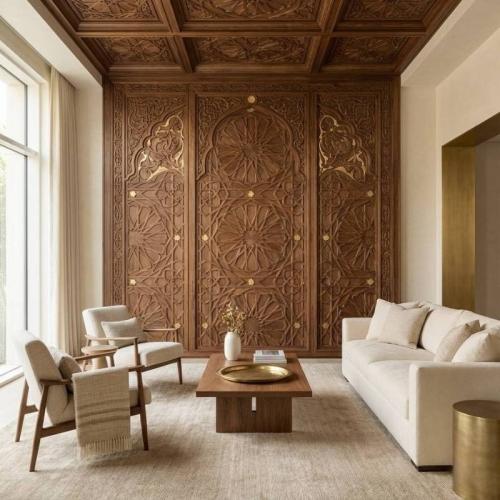
What Are Islamic Ornaments?
Their History, Types, and Use in Modern Interior Design
Islamic ornaments are considered among the most refined and profound visual arts produced by Islamic civilization. They are not merely decorative elements, but a complete artistic language that carries within its details a deep aesthetic and spiritual philosophy—one that reflects balance, infinity, and harmony with the universe.
Despite centuries having passed since their emergence, Islamic ornaments remain strongly present in contemporary architecture and interior design. In fact, they have become a symbol of refined taste, luxury, and authentic cultural identity.
First: The Historical Roots of Islamic Ornaments
Islamic ornaments emerged alongside the rise of Islamic civilization in the 7th century, influenced by Byzantine and Persian arts. However, they quickly evolved into an independent artistic school with a distinct and recognizable identity.
Islamic art relied heavily on abstraction rather than figurative representation, avoiding the depiction of living beings in many architectural and decorative contexts. Instead, it focused on:
- Geometry
- Botanical forms
- Arabic calligraphy
This approach was not purely religious, but also philosophical, expressing concepts such as:
- Infinity through repetition
- Unity within diversity
- Cosmic order and balance
For this reason, Islamic ornaments became integral to mosques, palaces, schools, homes, and even everyday objects.
Second: Types of Islamic Ornaments
1️⃣ Geometric Ornaments
These are the most widely recognized and iconic forms of Islamic decoration. They are based on:
- Polygons
- Multi-pointed stars
- Precise symmetry and mathematical proportions
Geometric ornaments create a visual sense of movement and endless expansion, making them ideal for:
- Walls
- Ceilings
- Wooden doors
- Mashrabiyas
2️⃣ Floral Ornaments (Arabesque)
Floral ornaments rely on abstract botanical forms such as:
- Leaves
- Branches
- Intertwined floral patterns
They are characterized by fluidity and elegance, often symbolizing:
- Life
- Growth
- The concept of paradise in Islamic thought
Arabesque designs are widely used in luxurious interior spaces and traditional majlis settings.
3️⃣ Calligraphic Ornaments (Arabic Calligraphy)
This form combines visual beauty with linguistic meaning, executed using classical Arabic scripts such as:
- Kufic
- Thuluth
- Diwani
- Naskh
Calligraphic ornaments are commonly used in:
- Walls
- Artistic panels
- Ceilings
- Custom decorative elements
They add both spiritual depth and artistic value to any space.
Third: Islamic Ornaments in Modern Interior Design
Contrary to common belief, Islamic ornaments are no longer limited to traditional settings. They have become a key element in contemporary interior design.
How Are They Used Today?
- Integrated with clean, minimalist design lines
- Applied in soft or monochromatic color palettes
- Executed using modern materials such as treated wood, metal, or gypsum
- Focused on a single statement piece rather than excessive detailing
Where Are They Commonly Used?
- Luxury majlis and sitting areas
- Feature walls
- Ornamental ceilings
- Dining rooms
- Entrance halls
- Villas, palaces, and private retreats
This balance between heritage and modernity is what gives Islamic ornaments their strong presence today.
Fourth: Why Designers Choose Islamic Ornaments
Because they:
- Give spaces a unique identity
- Remain timeless and unaffected by changing trends
- Express understated luxury
- Suit both residential and commercial interiors
- Convey cultural depth that mass-produced designs cannot offer
Islamic Ornaments at Zarkashat Art
At Zarkashat Art, we reinterpret Islamic ornaments with a contemporary vision while preserving their authentic essence. Our designs are handcrafted by skilled artisans using carefully selected materials and refined finishes.
We offer integrated decorative solutions including:
- Ornamental majlis designs
- Islamic-patterned walls and ceilings
- Dining rooms and custom furniture
- Made-to-order pieces tailored to the client’s space and taste
🔗 Explore our Luxury Islamic Ornamental Décor collection at Zarkashat Art
Conclusion
Islamic ornaments are not merely a form of traditional art, but a timeless design language that has transcended centuries and adapted seamlessly to modern life—bringing warmth, depth, and identity to contemporary spaces.
Choosing Islamic ornamentation today is a choice of enduring beauty, authentic craftsmanship, and refined taste that never fades.